
Blog
Science, strategy and field notes on Polymarket weather markets.
 ·3 min read
Build your own book
The series covered the why and the results. Now the how: five moves to reproduce the DEMFI approach with our services — read the signal, diversify, receive it, size it, and survive the slippage.
Read more →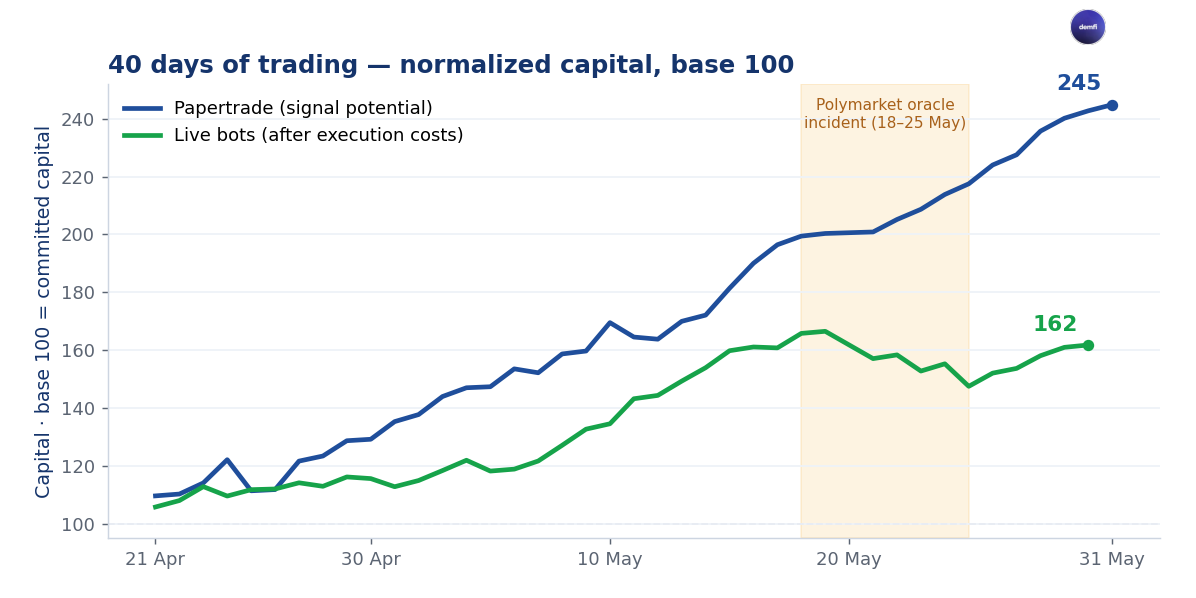 ·3 min read
Paper trading, our laboratory
Before a single real dollar is committed, every strategy runs for weeks in simulation. Forty days later, here's what the lab — and real money — produced. Numbers included.
Read more →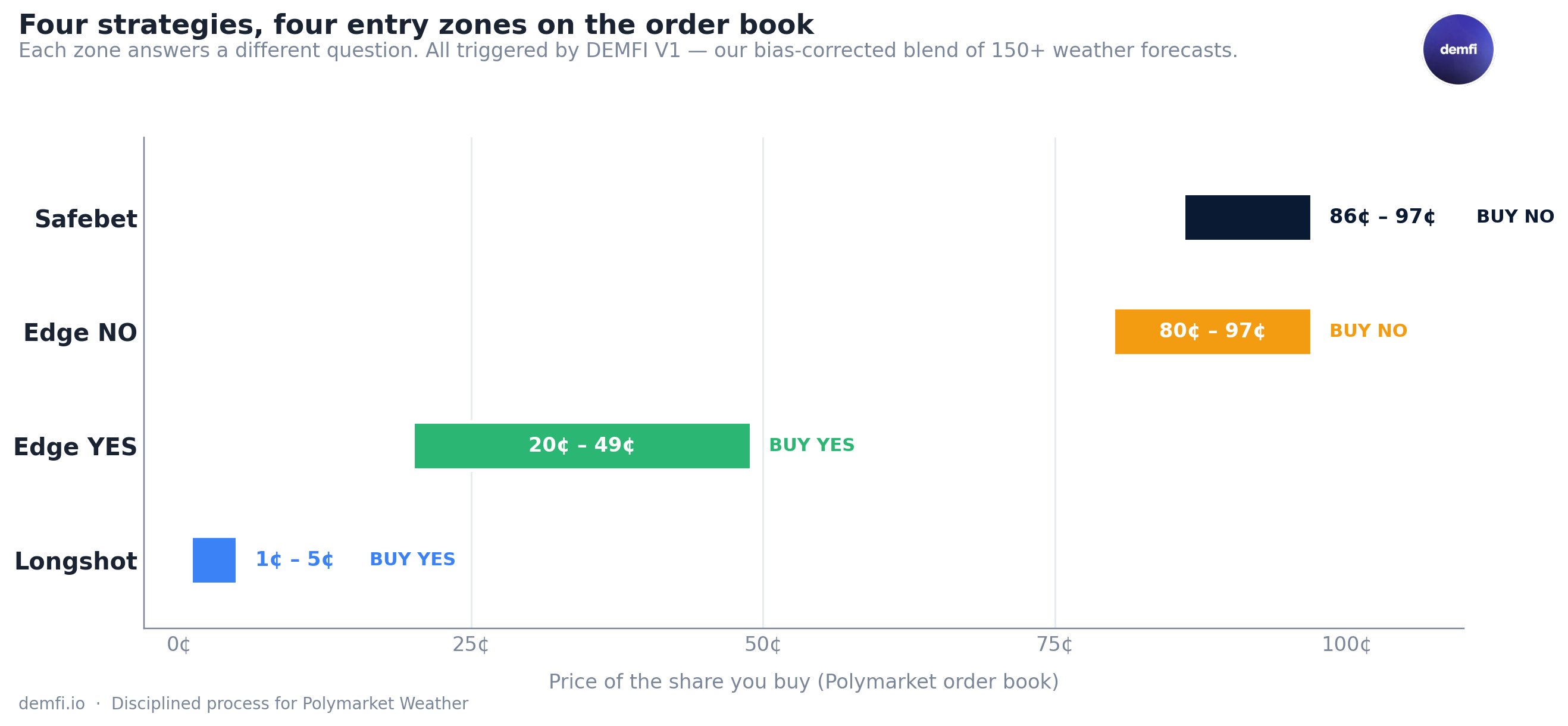 ·5 min read
Four strategies, one process
On Polymarket Weather, there isn't one good way to trade — there are four. Each answers a different question, and all share the same discipline. Here's the DEMFI menu.
Read more →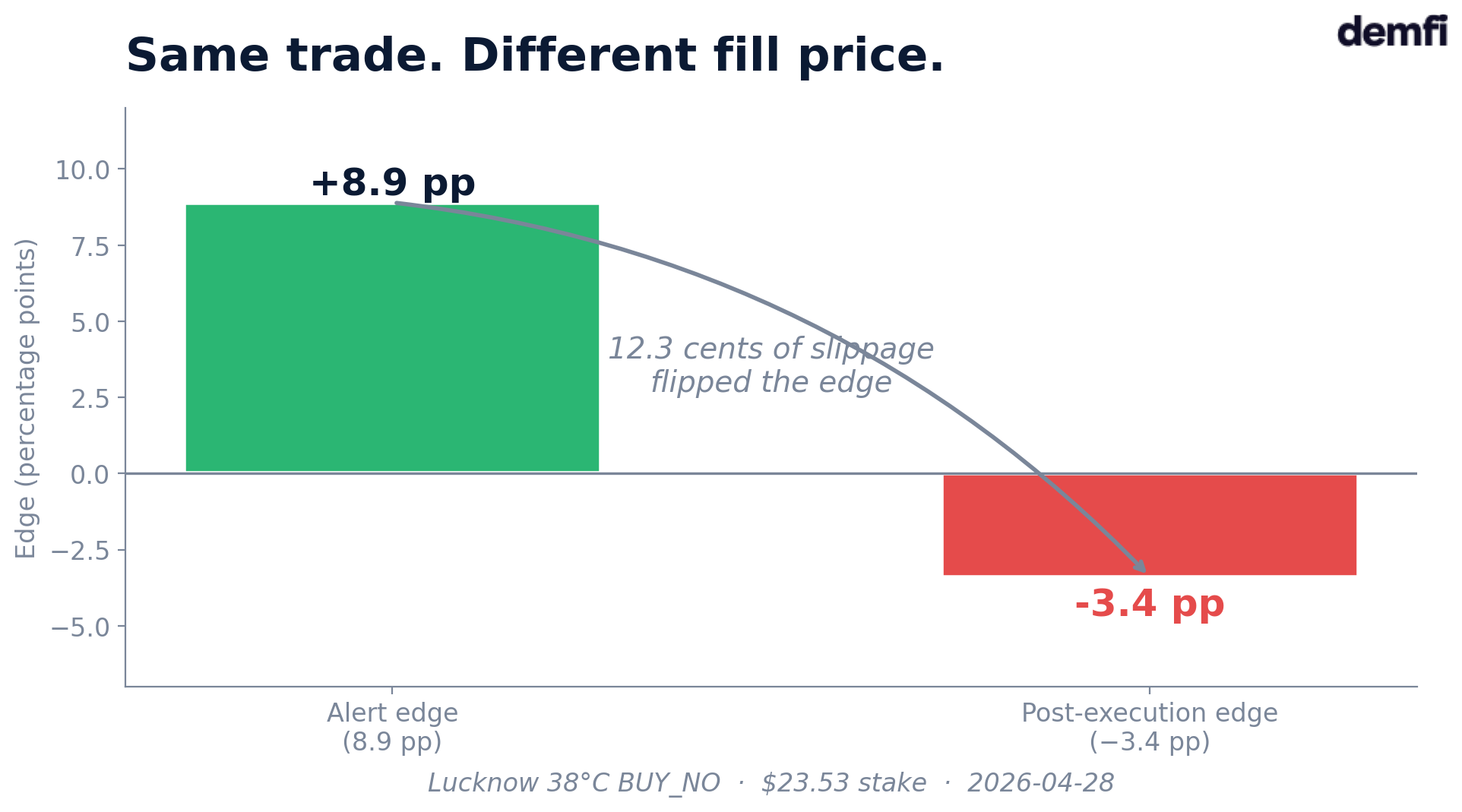 ·6 min read
Liquidity, the other uncertainty
A theoretical 8.9-point edge can become −3.4 points at execution. Not because the model was wrong. Because the liquidity wasn't there. On Polymarket's weather markets, there are two structural uncertainties: the atmosphere, and the order book.
Read more →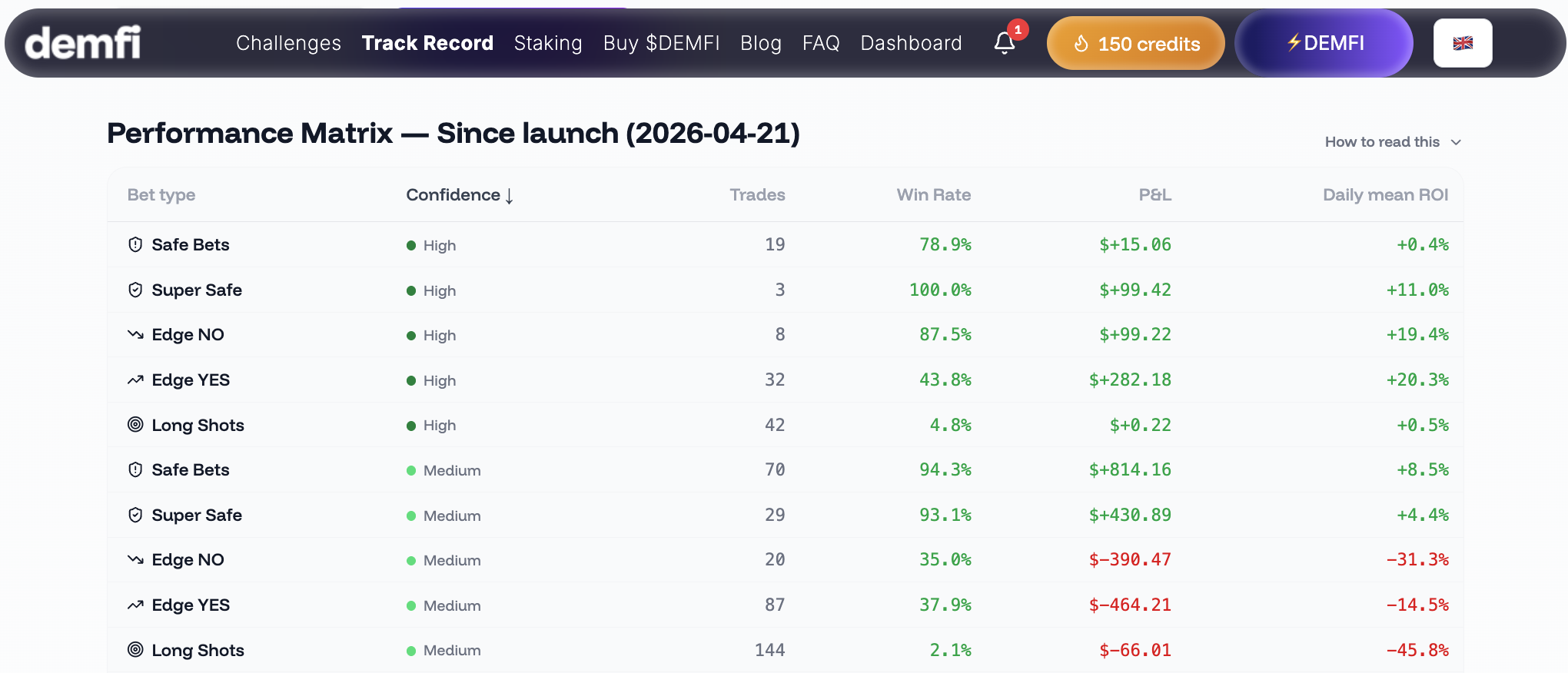 ·4 min read
Transparency as method
Most prediction services publish their best days. Not their worst. We publish both. Here's why a complete track record — wins and losses together — isn't a marketing argument, but a direct consequence of a scientific approach.
Read more →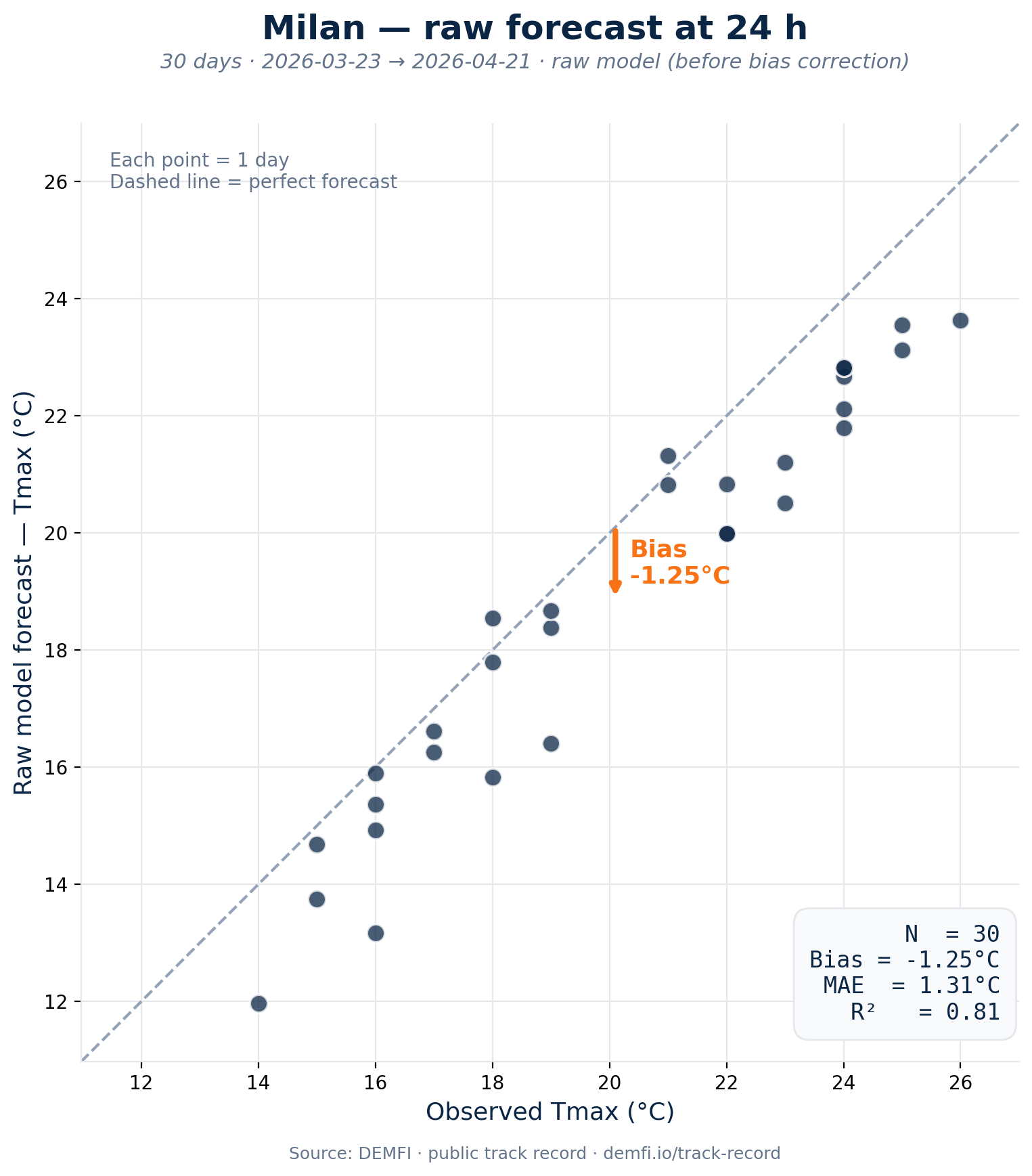 ·3 min read
For a Few More Degrees
On Polymarket weather markets, a forecast model can be precise — MAE near 1°C — and still ruin you. Not because it errs randomly, but because it consistently misses on the same side. How we measure that weather forecast bias, and how DEMFI corrects it in real time.
Read more →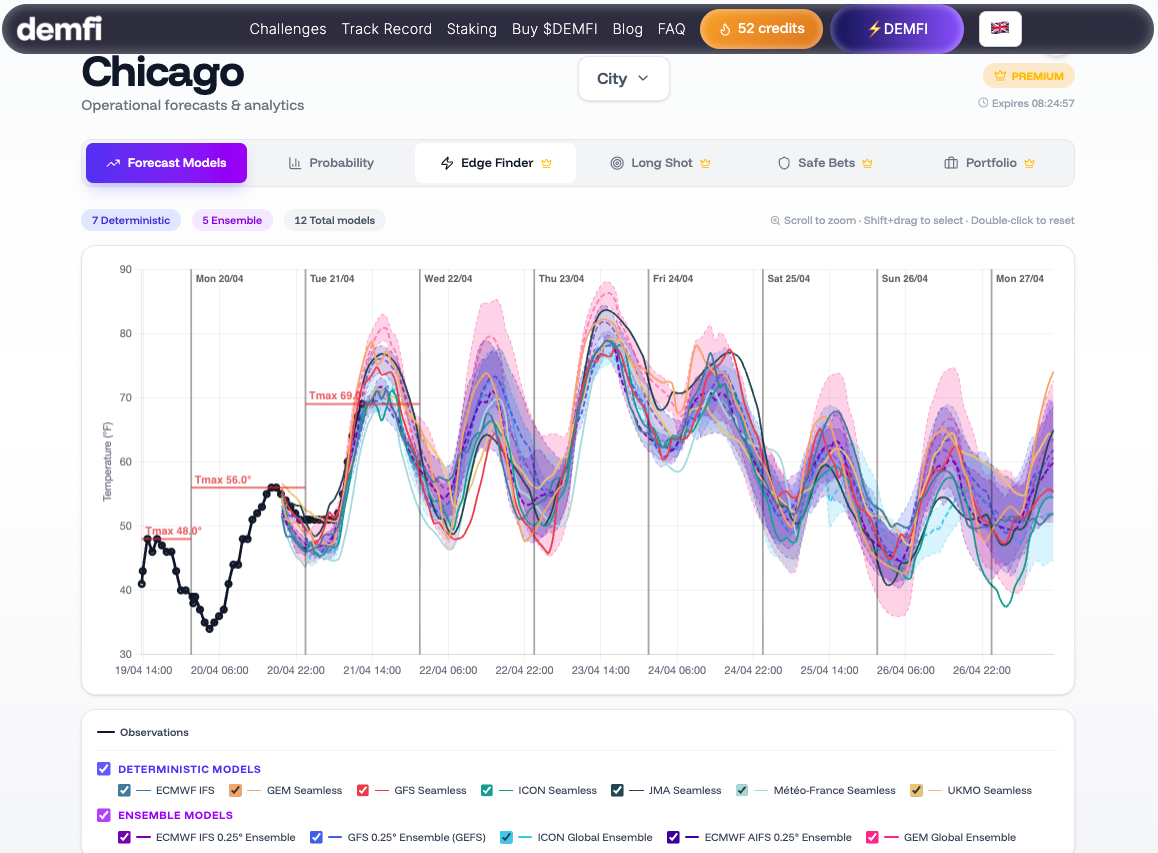 ·4 min read
Uncertainty isn't noise
Even a perfectly unbiased model often lands in the wrong bucket on Polymarket. Not because it's weak — because the atmosphere is uncertain by nature. Understanding what that means changes the way you read a forecast.
Read more →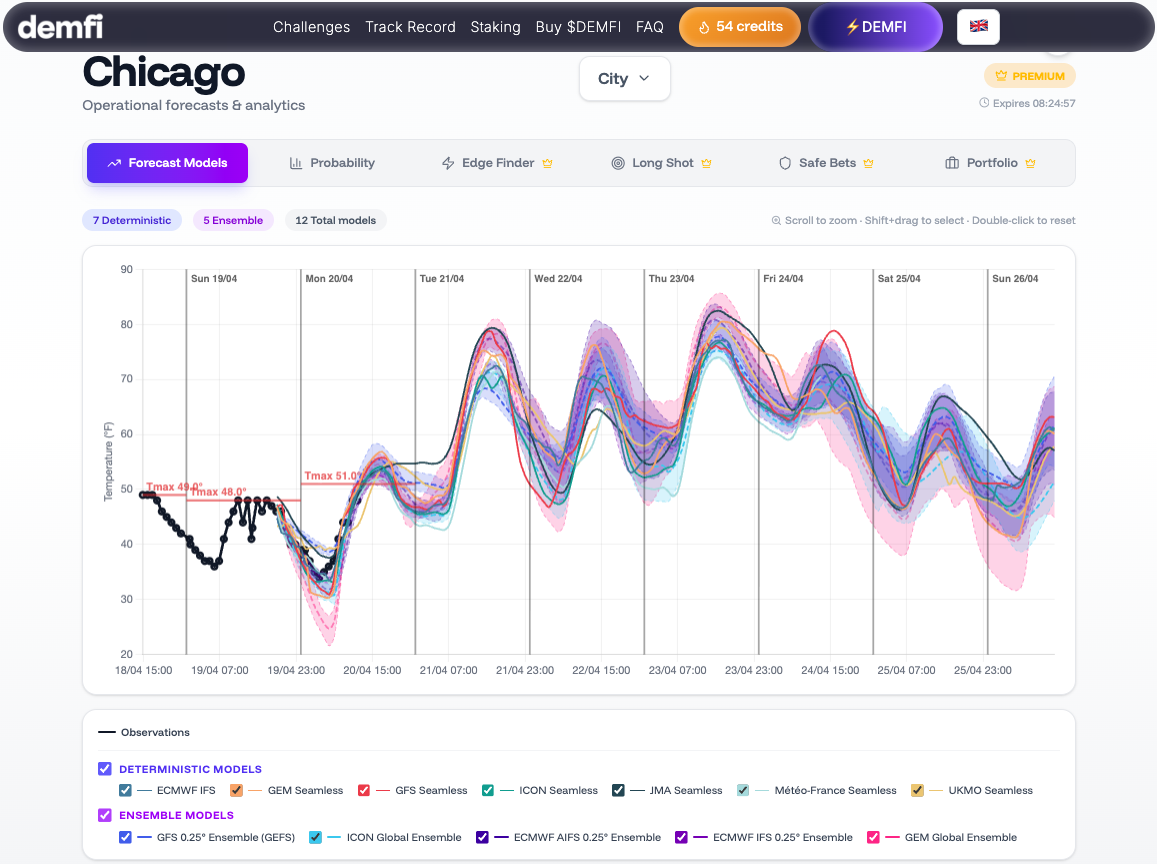 ·3 min read
Forecasting isn't winning
You can forecast tomorrow's temperature to within 1°C nine times out of ten and still lose on Polymarket. That's the paradox DEMFI exists to solve.
Read more →
Frequently asked questions
What is DEMFI?+
DEMFI is a weather forecast analytics platform built for Polymarket temperature prediction markets. We combine 14 numerical weather prediction models (ECMWF, GFS, ICON, JMA and more) with a real-time bias correction layer to produce daily probability forecasts for 50+ cities worldwide.
What is a Polymarket weather market?+
Polymarket runs daily prediction markets on the maximum temperature of major cities. Each market is split into buckets (for example 74–75°F, 76–77°F in the US, or 21°C, 22°C elsewhere). Traders buy YES or NO shares on whichever bucket they think the city will land in — prices move with the probability implied by the crowd.
What is forecast bias, and why does it matter for Polymarket?+
Forecast bias is a systematic offset between what a model predicts and what actually happens — for example, a model that consistently calls temperatures 1°C colder than reality. Even with a low mean absolute error, a biased model pushes traders toward the wrong bucket every day. DEMFI's V1 Markov correction removes most of that bias in real time.
How accurate are DEMFI forecasts at 24-hour lead time?+
On a representative city like Milan over the last 30 days, DEMFI's V1-corrected forecast hits a mean absolute error of 0.77°C and an R² of 0.93 at 24-hour lead time, with near-zero bias. Accuracy varies by city and weather regime — the full public track record is available at demfi.io/track-record.
Do I need to be a meteorologist to use DEMFI?+
No. DEMFI publishes ready-to-read probability distributions for each Polymarket bucket, plus edge and safebet signals comparing our probabilities to current market prices. The platform is built for prediction-market traders, not for meteorologists — the blog series explains the underlying science in plain language for anyone who wants to go deeper.