
You can forecast tomorrow's temperature to within 1°C nine times out of ten and still lose on Polymarket. That's the paradox DEMFI exists to solve.
If you've been betting on weather markets, you may know this frustration: you read the forecast, you check the price, you spot an opportunity — but the weather has other plans.
I'm not a bettor. I'm a scientist. When I discovered Polymarket, I analyzed it the way I'd analyze any complex system: determined to understand its mechanics. I invested, and I lost, to test the terrain from the inside. What I found convinced me that something was missing from these markets — a bridge between weather science and the people putting money on the line. DEMFI exists to build that bridge.
The real problem isn't forecasting. It's deciding.
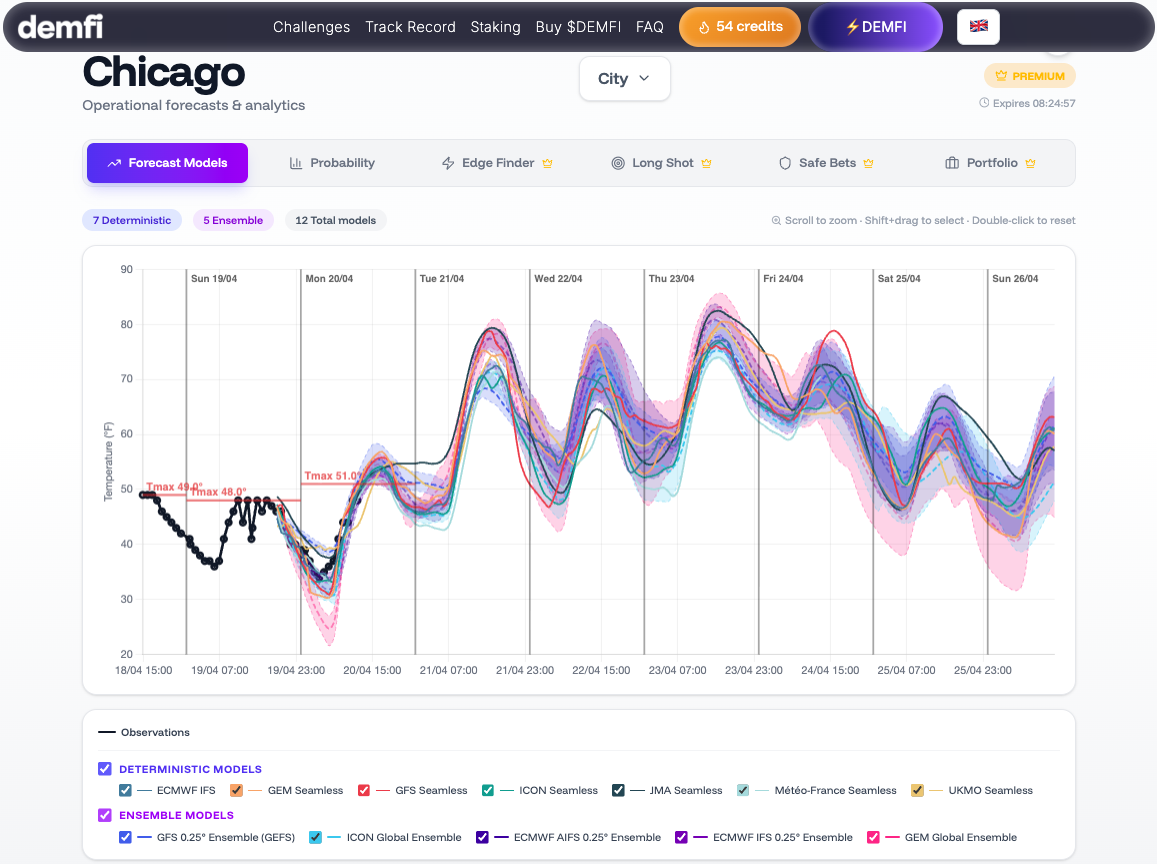
Every day, more than 150 temperature forecasts are produced worldwide by the largest meteorological centers for any given city, each trying to give the best possible estimate of what the temperature will be in the coming days. These forecasts come from American, European, Japanese, Canadian models, and more. Some give a single number, others give sets of up to 51 values. Each tells a slightly different story.
The best bettors use forecasts from one or two models — usually the ones they find for free online. And they bet.
The problem: all of these forecasts are biased. Some models run too warm over cities because they poorly capture trapped heat or local effects like sea breezes. Others underestimate clear days. These biases aren't bugs. They're known, measurable characteristics — and, good news, they're exploitable.
But to exploit them, you have to measure them. And to measure them, you have to accumulate days upon days of observations set against days upon days of forecasts. That work had never been done for Polymarket bettors. Until now.
What we've built
At DEMFI, we process more than 150 forecasts per city in real time, every day. The result lives in two interfaces:
- Forecasts: what the raw models say.
- Probability: what it implies for the market's YES/NO buckets, either from raw data (V0) or from bias-corrected data (V1).
Our goal is simple to state, less simple to pull off: identify as precisely as possible which buckets will come out YES and which will come out NO.
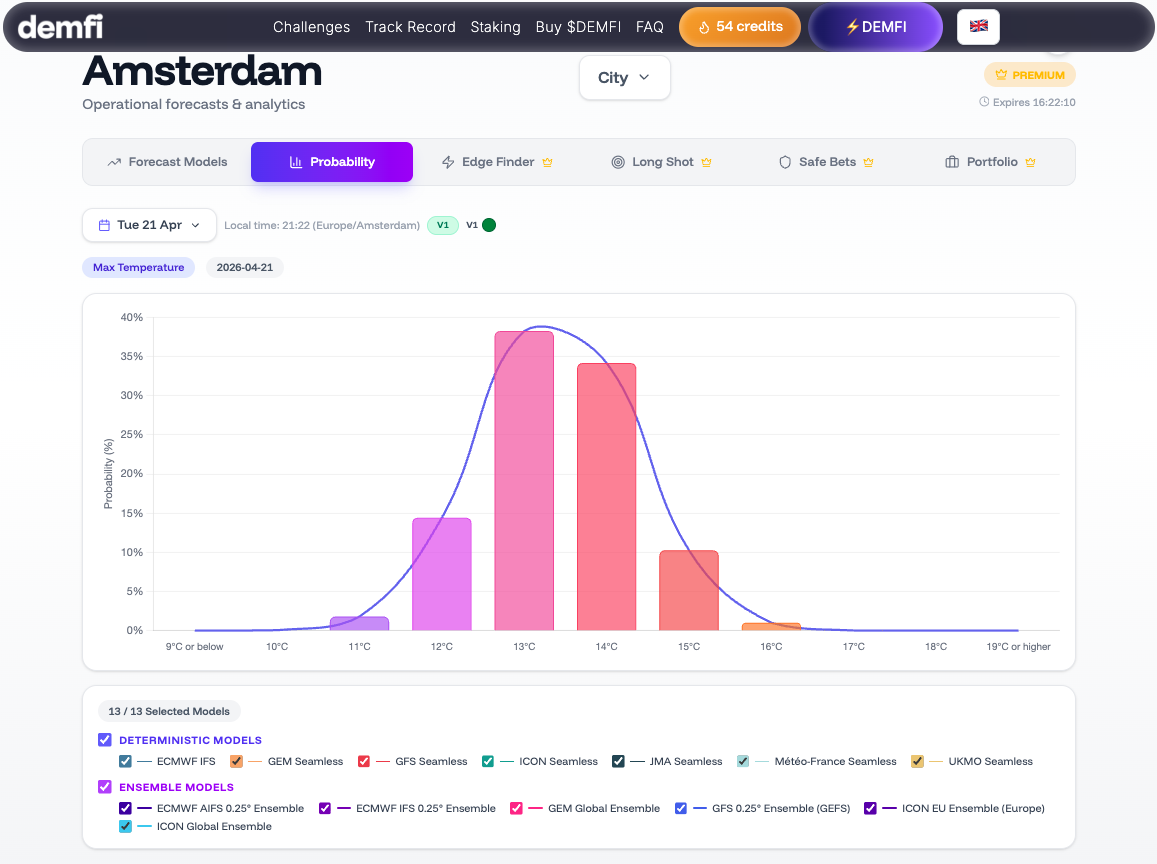
The V1 currently in production focuses on bias correction. For each model and each city, we know whether it tends to forecast too warm or too cold, at what time of day, and under which conditions. Once corrected, these forecasts are more honest than any single model taken in isolation. And we score our confidence in each city's forecast for each of the next five days.
The real winning strategy
Forecasting better isn't winning. Winning is making the right decisions with information that's imperfect by nature. That's a risk management and portfolio construction problem.
The Polymarket market is alive. YES/NO prices move with every trade. An opportunity invisible at 10am can become obvious by 3pm — and disappear by 5pm. Conversely, the bucket that's scientifically "most correct" isn't always the most profitable if its price has already adjusted.
That's why everyone can win by following the same method, without ever taking the same positions. Each person enters when the window opens for them, on the buckets where their capital, their horizon, and their risk appetite align.
The series ahead
This post is an introduction. In the coming weeks, I'll dig into:
- How to measure a weather bias, and why it's non-negotiable
- Why the "most likely" bucket isn't always the most profitable
- How to build a coherent weather-bets portfolio
- What "uncertainty" really means in a forecast, and how to use it
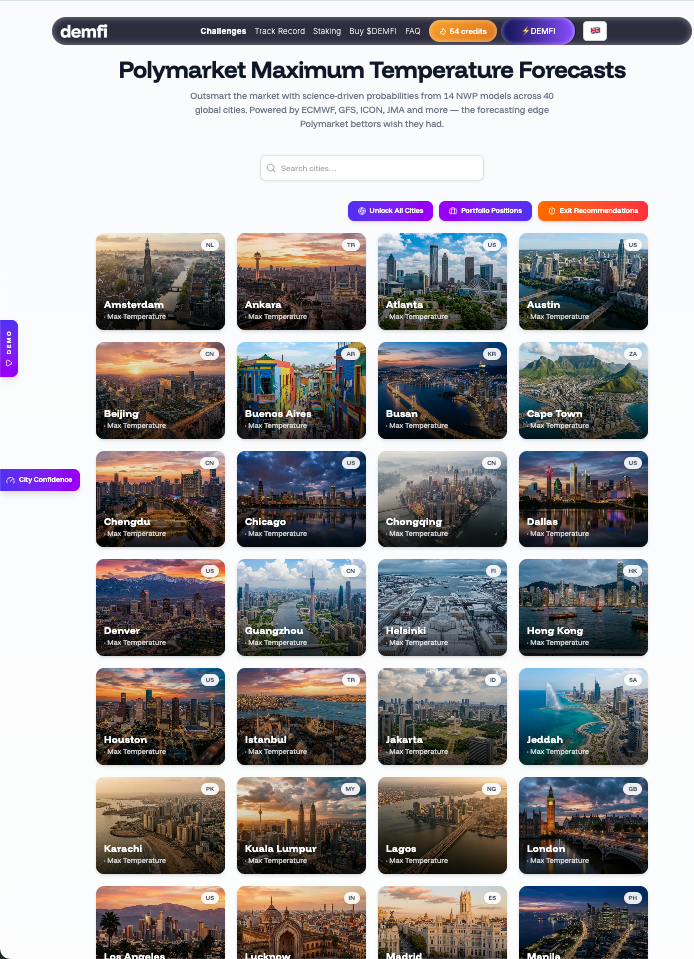
The goal is to give you access to the most precise information and to the scientific rigor we bring to the problem — so you can build a winning strategy that's truly yours.
Welcome to DEMFI.
Stay sharp,
— JP