
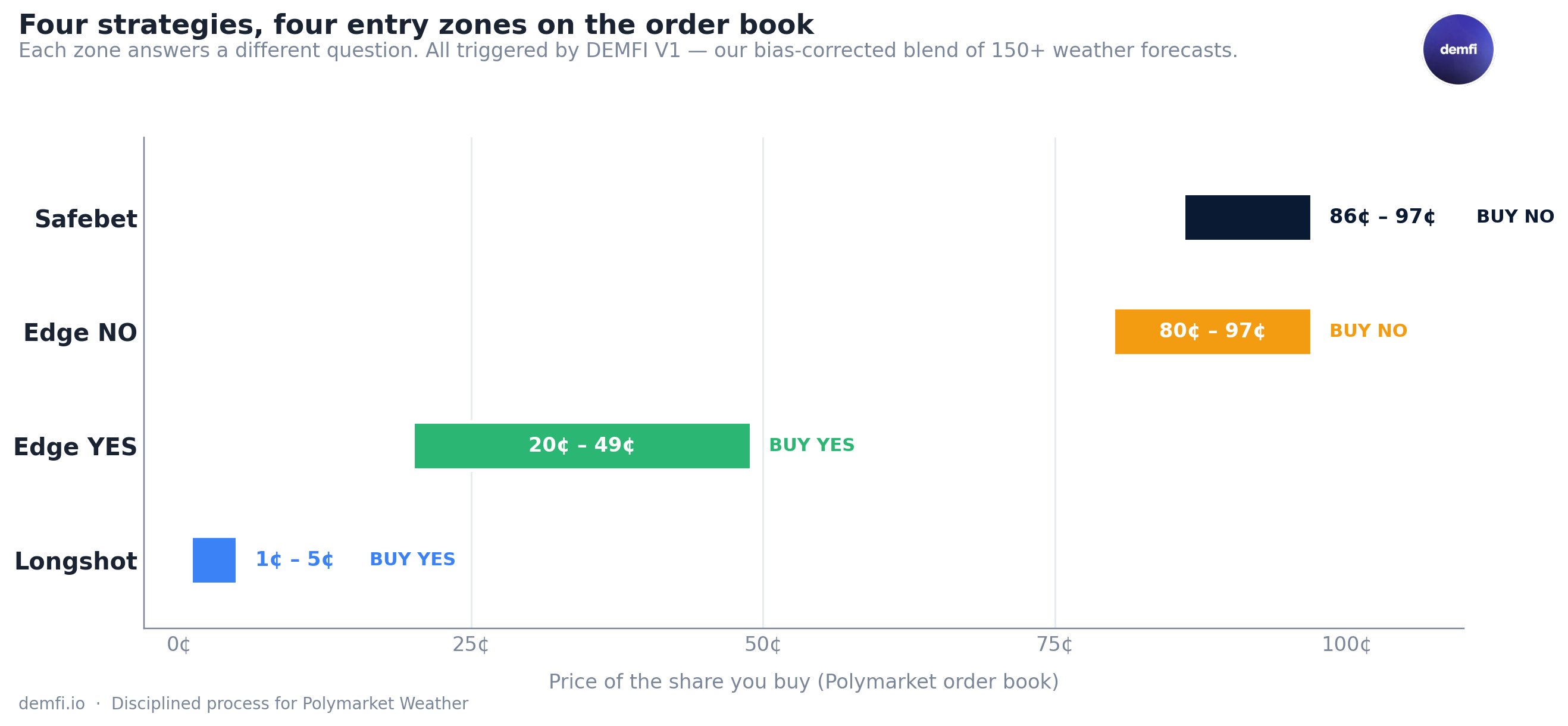
On Polymarket Weather, I'm often asked: "OK, you have the forecast, you have the confidence, you have the market — but concretely, what do you do?" The answer isn't one strategy. It's four.
Four families of trades. Four risk profiles. Four reasons to enter. None makes you rich on its own, and none works every day. But together, with a shared process for sizing and exit, they turn quality information into measured exposure — meaning risk you take, never risk you suffer.
Here's the menu, and what's behind every line.
Safebet — defensive high conviction
The market is pricing a temperature bucket that physics has already ruled out. Not "improbable": excluded. Tomorrow in Lucknow, the market still quotes the "38°C or higher" bucket at 12 cents on the NO, while the 14 models converge on 32°C with a 0.8°C variance. The NO is expensive because it's almost certain — and that's exactly what we want to buy.
Profile: high entry price (≥ 0.85), modest expected gain (5 to 15 cents per dollar staked), low volatility. This is the "high conviction, low amplitude" trade. Its main enemy isn't the forecast — it's order-book liquidity, which can push the fill price beyond the breakeven threshold.
Edge YES — mispricing with a 2:1 ratio
Market and science diverge. Our models see the "23°C or higher" bucket in Tokyo tomorrow at 65% probability. The market quotes it at 42% (the YES trades at 42 cents). The gap is measurable, calibrated, persistent. It's a mispricing.
But a good forecast isn't enough to justify a trade. Edge YES only enters when three conditions align: the DEMFI bucket exceeds 50% probability, the gap with the market is at least 5 points, and the YES costs less than 50 cents. That last constraint is deliberate: at 50 cents, the payout is 2x the stake — meaning we accept being wrong half the time and break even. Below 50 cents, every winning trade refunds more than every losing trade. That's the 2:1 ratio discipline: not the prettiest edge on screen, the most defensible against error.
Edge NO — not an inverted Edge YES
Edge NO isn't a mirror of Edge YES. It operates on the other end of the order book: the market endorses a bucket by quoting the NO very high (≥ 80 cents), DEMFI sees the conviction less solid than the price suggests, and the gap is worth the trip.
Its difference from a safebet isn't a question of price — both buy expensive NO. It's in the DEMFI conviction: a safebet requires near-scientific certainty (exclusion probability ≥ 90%); an Edge NO settles for a clear but more modest disagreement. Similar gain profile, slightly wider risk profile. Since the market's natural buyers concentrate on the YES, the NO is more liquid to receive at the right price — provided the conviction gap holds after the fill.
Longshot — the systematically underpriced outsider
The market quotes the extreme bucket — 38°C+ in Madrid in May, 0°C in Mexico in August — at 5 or 7 cents. Most bettors see a losing product and pass. But when 3 models out of 14, or a 51-member ensemble with a tail distribution warm enough, see the event attainable at 12% — paying 2 cents for a ticket to 100 cents becomes a trade with very different parameters.
Profile: low hit rate, massive unit gain. Requires the patience of a hundred tickets for the statistics to express themselves.
The shared process that makes all four exploitable
Four strategies, one process. Without it, quality information ends in losses:
- Fractional sizing. A good forecast never justifies a large stake. Each trade size is derived from a fraction of theoretical Kelly, calibrated to absorb the residual error inherent to any weather forecast. Safety margin is built into sizing, not into conviction.
- Slippage gate at execution. If the fill erodes theoretical edge below the breakeven threshold, the order is canceled before it ever reaches the book. The rule applies to all four families.
- Disciplined exit. Edge exits on peak migration signal. Safebet exits when the DEMFI forecast walks back on the sold bucket. Longshot never exits. Three rules, one discipline.
All these parameters — Kelly fractions, slippage thresholds, exit logic — are under continuous evaluation on our paper trade flow. Before any change reaches our real bots, it has run in simulation on weeks of real data. That's the central role of paper trades at DEMFI, and the subject of the final episode in this series.
What DEMFI gives you
On the platform, these four strategies are exposed in real time as four distinct alert streams, city by city, bucket by bucket. Each alert carries a confidence level — HIGH, MEDIUM, LOW — summarizing whether the market-model gap is solid or marginal. No decision is made for you: we publish the information, you decide which stream and which confidence match your capital and your horizon.
In the episodes that follow, I will unpack each of these families with its numbers, its real cases, and its traps. But first: the bankroll and sizing mechanics that make them all exploitable. Without that, the world's best information dilutes into too-broad exposure.
Connect your wallet at demfi.io/en — one monthly plan covers every city — watch the four streams on the cities you follow, and read what comes next with the real alerts in front of you.
Good analysis,
— JP